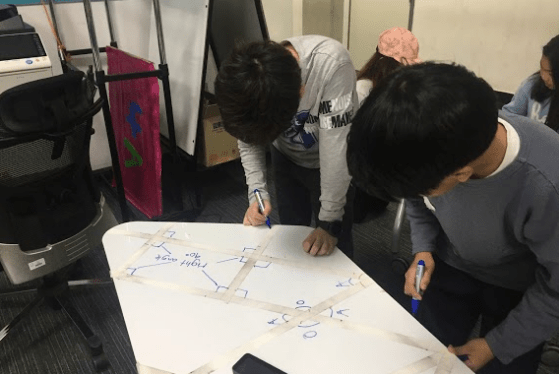
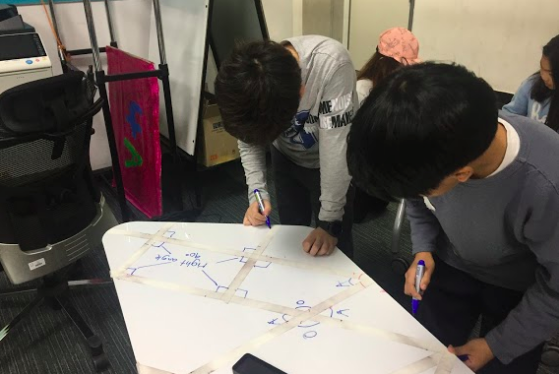
This was a fun center idea for students to determine Obtuse, Acute, and Right Angles. The kids taped up some old tables outside in the common space to create intersections of different sized angles. Next, in small groups the class took turns labeling each angle with it’s corresponding name based on it’s size.
Labeling Tables
A few days later, once we introduced angle degrees and measurement using protractors, the kids were again able to use these tables in small groups, this time to measure how big each angle was. The tape provided an extra challenge, as the kids figured out they needed to measure from the inner tape line
I believe Math Talks are one of the best methods to both challenge advanced students and support struggling students. In a math talk, students are given a problem, or question, to which there may be one or multiple answers, but there are many strategies of which this answer(s) could be found.
Steps to a Successful Math Talk
Have students work individually on the problem or question introduced– I tell my students, if you have figured out one way to solve the problem, do another. Find as many strategies or solutions as you can.
Walk around and jot down what methods students are using– I keep a running list of strategies that both work and do not work with names next to them so I have a plan for who to invite up to share their work.
Come back together as a class to share– I call on the students who’s names I wrote down and tell them which strategy I would like them to talk about.
Students teach each other– I used to write down the answers for my kids and have them talk through their thinking as I write, but I’ve found that once my class feels comfortable with each other, the students can write and explain their own strategies while using their presenting skills.
Allow the class to ask follow-up questions once a student shares– I also ask clarifying questions, especially if the student arrived at an incorrect solution so that as a class we can discuss the misconception. At the end of each share, I ask the class, who else used this strategy? This is important as it allows students who were not asked to share to be recognized for their work.
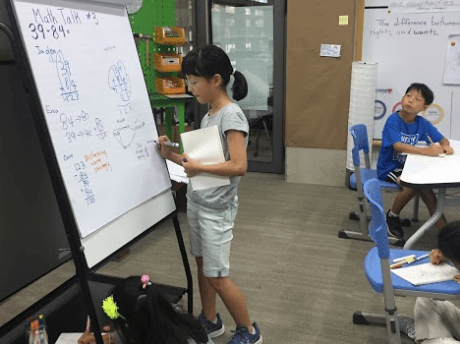
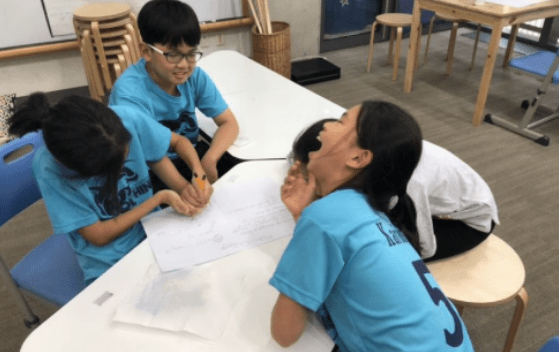
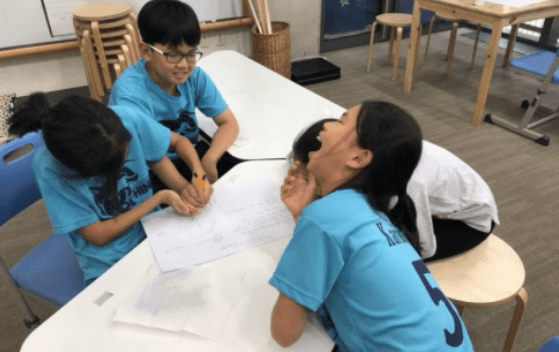
We use Math Talks quite frequently in my 4th grade classrooms. I found the Math Talk from which these pictures are taken to be a great pre-assessment for my students in terms of addition. Most of my students were able to use the standard algorithm for addition to solve the question 39+84=. Many of my students chose to use some type of visual representation for the problem, either a number line, or an organizer with breaking apart the numbers. One of my advanced students was even able to recognize that 39 and 84 are both divisible by 13 and solved this problem by first dividing each by 13 then multiplying 13 by the total he divided by.
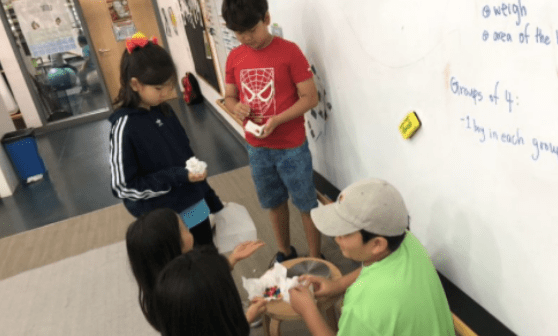
Who doesn’t like mixing food with learning? Today we investigated how many M&M’s we thought were in one bag using a scale to weigh in grams. As a whole class, we inquired into how the scale works, playing with it’s functions. Next, I drew popsicle sticks to determine groups of four students to work together to reach a conclusion of how many candies there were. The group got to pick either a crispy bag of m&m’s or a regular bag of m&ms to experiment with. The rules were simple: use any strategy you want to figure out how many m&m’s are in the bag. Yes, you can open the bag and use the m&m’s but no, you cannot count the m&m’s one by one, you must somehow use the scale.
Hint: Look at the back to figure out what the total weight of the package is.
Working in small groups to organize our thinking Weighing the M&M’s in small amounts
The results for this lesson were varied. Many students got frustrated since when they weighed only one m&m the scale weighed 0kg but when they weighed two m&m’s it sometimes weighed 2kg. Regardless, the students had fun, used teamwork, developed skills on how to use a scale, and were creative in their approaches to get reasonable results whether or not they were totally accurate.
During a weekend trip to Seoul, I went to a pizza shop in Itaewon selling a wide variety of types of pizza. My friend and I debated over whether we would pizza multiple slices or a whole pizza, and ultimately decided that we would go for slices to try more kinds. Good thing we did since each slice was huge, and 3 slices made up half a pizza! This got me thinking . . . mathematically, this wouldn’t make sense for the pizza shop to even sell whole pizzas at all! This is how I got my idea for a lesson I taught the next day at school.
Act I: What do you notice in this picture? What do you wonder about what you are looking at?
Students discussed that this must be a pizza shop and how the numbers represented the prices. They determined that triangles must mean prices for single slices and circles must mean prices for full pizzas.
Act 2: How many slices do you think the pizza shop should sell in their whole pizzas?
We discussed what they remembered from a previous unit on businesses and how businesses normally price items in order to make a profit.
Act 3:This pizza shop sells 6 slices per pizza. How does this compare to your answer? Do you think the pizza shop should change the number of slices per pizza? Why or why not?
Central Idea: Experimenting and investigating lead us to uncover how the natural world works.
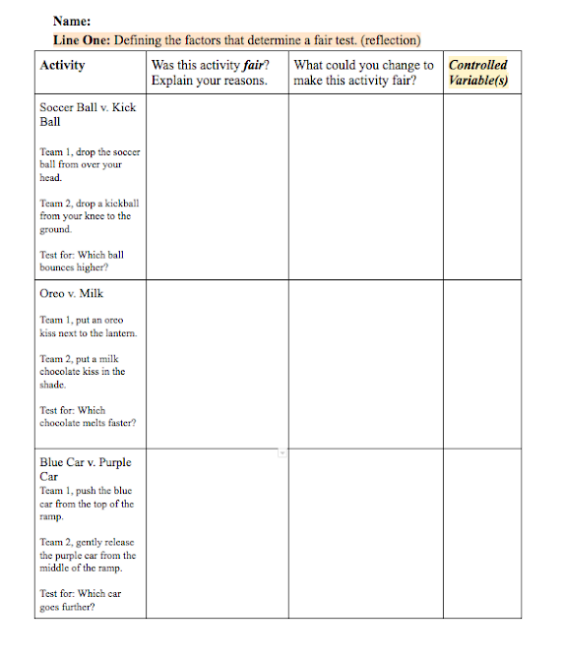
Line of Inquiry: Defining the factors that determine a fair test
What? Students participate in “unfair” tests with a small group in order to determine what makes a test accurate.
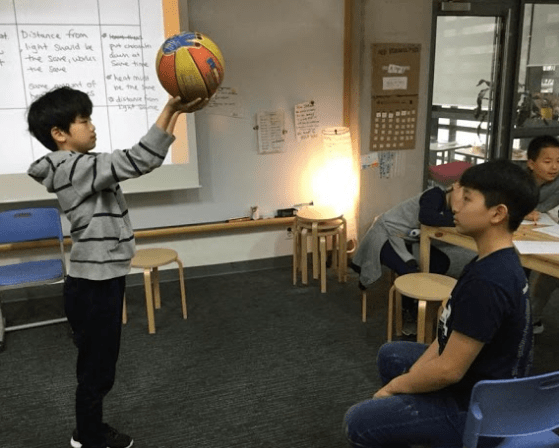
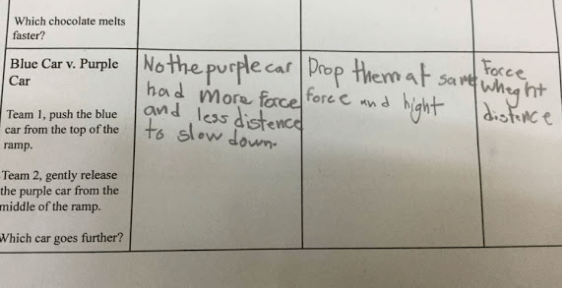
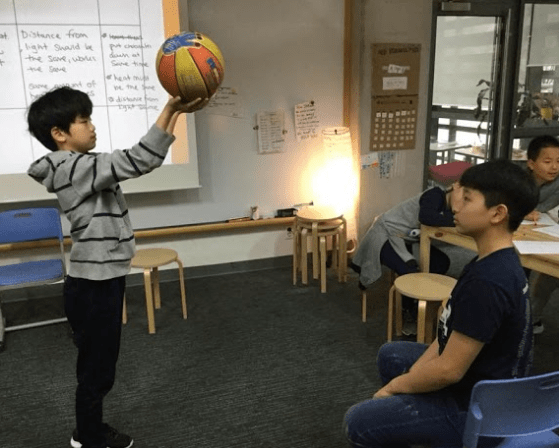
How? After a whole class example of how to perform the first activity on the sheet to the left, each group followed the procedure to complete all three activities. For the first activity, a soccer ball and a kick ball were dropped from different heights and the bounce height was to be recorded. My students were able to determine that the data they gathered from each test was not valid. Additionally they identified what conditions need to be controlled (controlled variable) in order for the results to be accurate.
Why? Scientists do everything in their power to obtain accurate results when conducting experiments in order for their discoveries to be valid. Understanding what makes a test unfair will help my students set up experiments and activities that give proper results.
Student answers that demonstrate knowledge of a fair test and that there can be multiple controlled variables. Ball Drop Test from different heights
Central Idea: Imagination and creativity are powerful tools for extending our ability to think and create
Line of Inquiry: The ways in which we inspire imagination
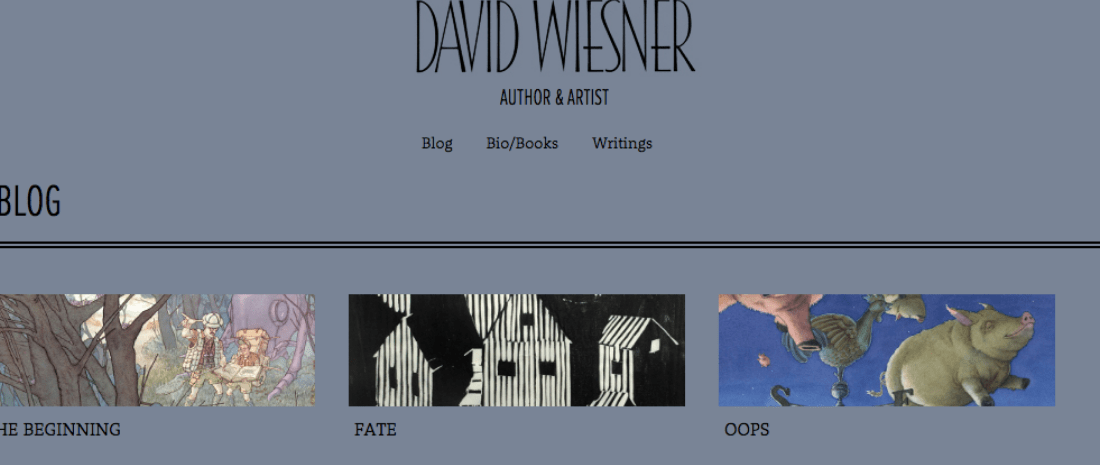
What: We read several books by popular children’s writer David Weisner including Sector 7 and Tuesday. David Weisner writes mainly in pictures instead of words. After reading these books, I had students look through David Weisner’s online blog to determine what in his life inspired him to create such unique stories.
Copyright David Wiesner
How: I did several whole class read alouds of David Weisners work so student were familiar with his unique way of writing and illustrating. I next had students investigate on his blog where these ideas came from. Students used their macbooks to research and read any of the posts. As the read, they wrote down on sticky notes any life experiences that Weisner references in his blog that sparked the imagination for his picture books. There were many clear examples in his blog where he references an event from his childhood or experience as a young adult.
Why: The most creative works are routed in the identities of the people who created them. In order for my students to be creative, they must understand that individuals are inspired from their passions and their histories.
Central Idea: The act of people coming together to support community issues can be a force for change.
Lines of Inquiry:
The needs of a community
The responsibility of individuals towards supporting communities (think in terms of concentric circles, how do you start with yourself and move out to the bigger community)
Impactful action
What? I took my students out to the school garden to investigate. After, we read the book The Garden on Green Streetby Meish Goldish as a class.
How? First, I reviewed in the classroom my expectations for student behavior in the school garden, including how to be responsible where we walk and what we touch. Next I posed the question: How does our garden function? After giving them 10 minutes to explore, I gathered the class back together to discuss our findings. Students reported that people, plants and animals work together to help our garden. Teachers volunteer time, parents help after school and student gardening clubs come together to keep the plants healthy. After this conversation we read the book which discusses a fictional community garden and people banding together to save the garden from construction. This book had students consider possible impactful actions in connection to the roles and responsibilities the townspeople took to make a change.
Why? Students need hands-on experiences to deeply connect to the lines of inquiry. Since this garden was on school grounds and most students had been at least one time before, this was a perfect opportunity to build on student prior knowledge. The students came away from this lesson more knowledgable about the gardening community and its needs at our school and more curious about the nature they explored during the investigation portion of the lesson.
One day, I was asked to substitute as the homeroom teacher in one of the 4th grade classrooms I intern taught in. The regular homeroom teacher provided me with the lessons he was planning on doing that day including two power-point presentations; one on Haikus and one on similies. Each power-point conveyed information to the students in a lecture format with limited student engagement.
I decided to revamp these lessons, giving my students credit for the knowledge they already knew. Instead of following these plans, I used the content as guidelines for an inquiry based approach. Here is the first lesson I did on Haikus.
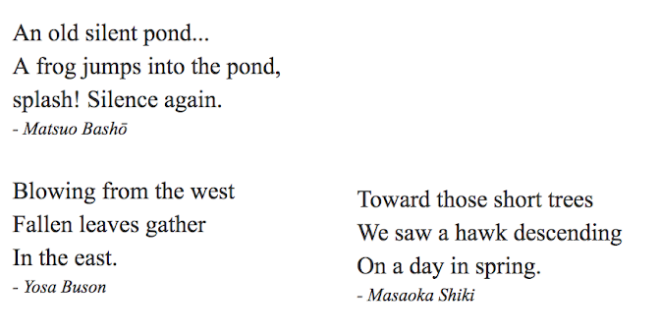
I put these three poems up on the board, and asked my students:
What do the following poems have in common?
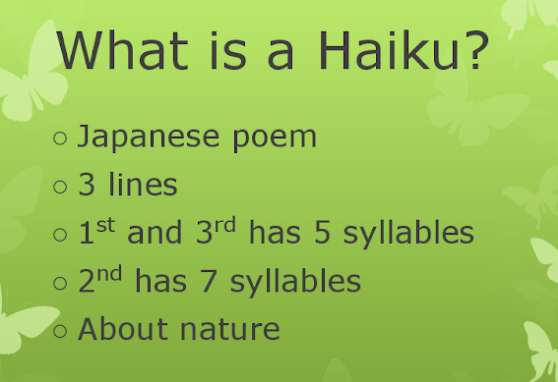
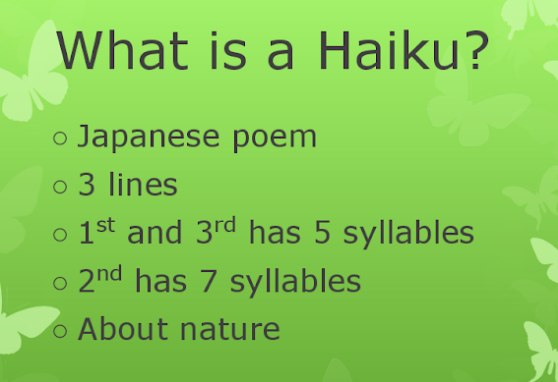
Power-Point Slide on Haikus
Student Answers:
They’re about nature
I think they might be Haikus
The first and third poems are Haikus because they follow 5-7-5 syllable pattern
Could they all be Haikus even if they have a different syllable pattern?
They have to do with the seasons
They have to do with movement
I think the poets might be European looking at their names?
I know Haikus are Asian, are they Chinese?
The poets are Japanese
My students came up with the same ideas that were on the bulleted list in the power-point and more. They also had the opportunity to analyze famous poems that will likely emerge again throughout their education and life. This was a powerful moment for me as a first year PYP teacher, as I proved that showing students stacks of texts and having them analyze the content of st
Teachers often spend many lessons having students write various styles of poems which follow a specific theme or style of writing. Students are taught a kind of poem, how to write it, and maybe some literary devices to help them along the way, without always understanding the why people write poetry. What is poetry really?
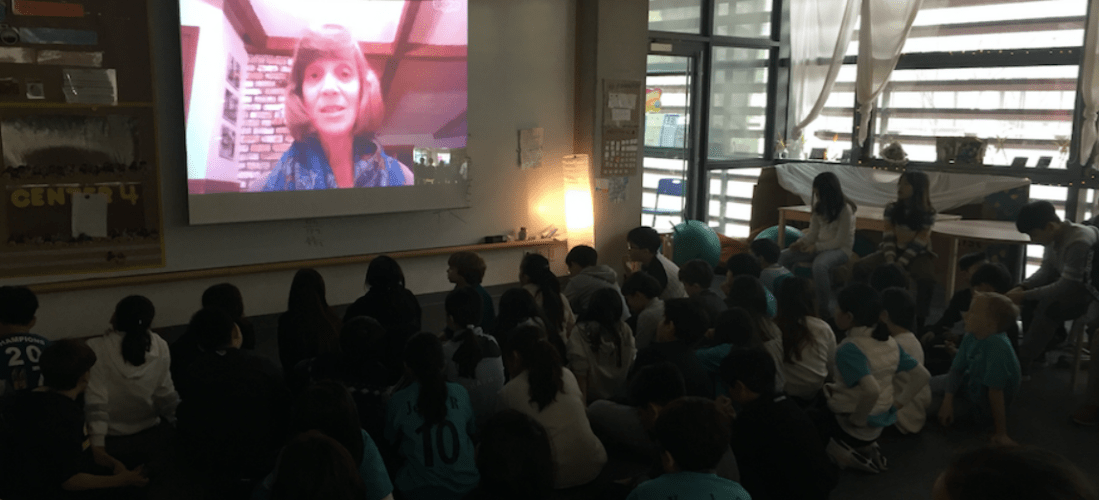
My mom is a poet, and I once had my students Skype her so that she could give a reading of some of her poems. My students had never heard a poet read before and so I wanted to give them some insight on the passion behind poetry, the tone of a reader, and what inspires someone to write. I did a simple exercise with my students in preparation for this Skype call, which I believe teaches the purpose of writing poetry.
Skype Call to Mom!
First, I had my students look at a picture of Piute Creek, a location in Yosemite National Park. An author who inspires my mother by the name of Gary Snyder has a poem titled Piute Creek written about this location. I had my students close their eyes for a minute and picture themselves there. What would you see? smell? be doing? Be in that picture. Next, I read my students Gary Snyder’s poem. This allowed my students to understand how feelings and experiences could be put into words.
Next, I read my students a poem by Robert Frost, The Pasture. This time I did the opposite. I read the poem first, and then after asked my students to tell me what a picture of this poem might look like. If I had had more time, perhaps I would have had my students each draw a picture, or interpretation of this poem. The takeaway from this exercise was that poetry is designed to bring out experiences, to tell stories, and to fill a readers head with imagery.
My students were inspired to find pictures from home or take pictures at home of something that inspires them to write poetry about as a next step. This lesson also directly connected to our unit of inquiry on imagination and inspiration.
Children find meaning in, in the same way that adults only want to write about something they enjoy. And what do Kinder students love to do? Play! Therefore, teaching kids writing through play seemed like a natural fit when I wanted to teach them “How-To” writing. Here is the 2 Day Outline:
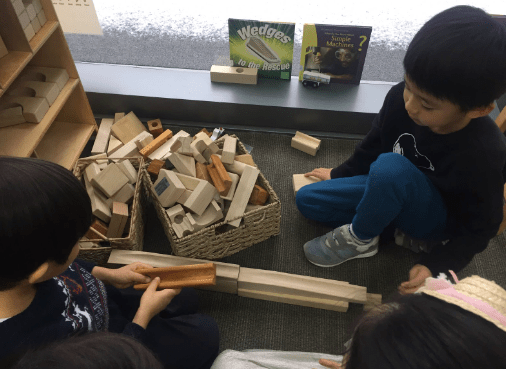
Day 1, PLAY: Before I began this lesson, I arranged different toys around the classroom for my students to use during a play session including dominos, blocks, tubes and a marble run. Since this lesson was in connection to these Kinder student’s unit on Force and Motion, I made sure all these toys could somehow be used to demonstrate this idea.
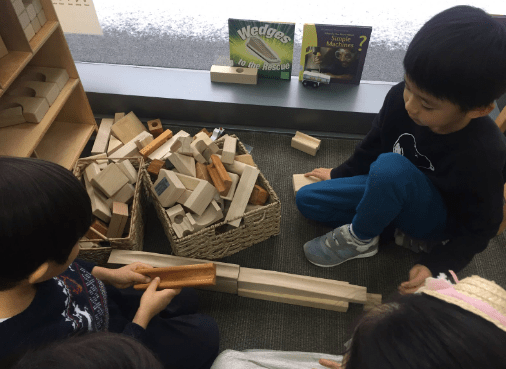
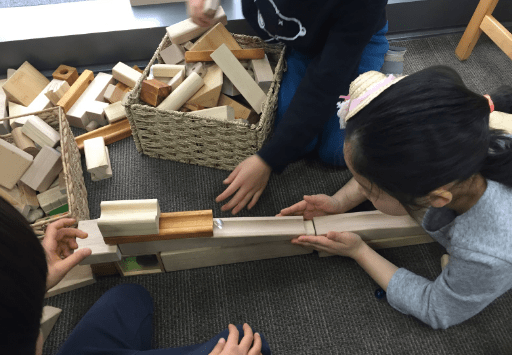
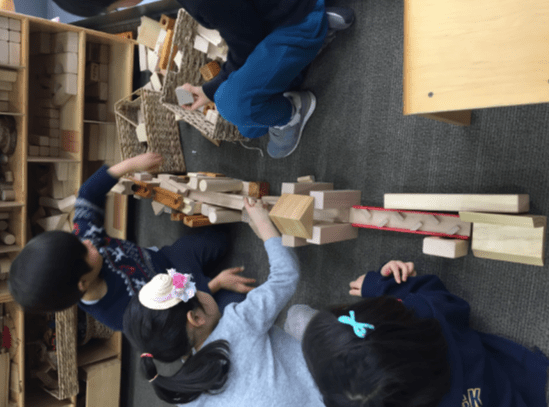
I started this lesson with the whole class, reviewing words and ideas that the students already knew about Force and Motion. The kids were great, talking about push and pull and friction and how these work with objects. Next, I broke the students into small groups and assigned each group a toy to play with. I told the kids that their group’s job was to build something that demonstrated what they knew about Force and Motion. I told them I wanted them to consider what the beginning of their project was going to look like, what the middle would look like and how they would know they were done with their creation. Below is a sequence of what some of their play looked like.
BeginningMiddleEnd
During their play time, I ran around like a crazy teacher taking as many pictures as possible of each of the 4 groups to use during the writing activity on day 2.
Day 2, Sequence & Write: For day 2, I made laminated sequence cards for each group including one picture from the beginning, one picture from the middle, and one picture from the end of their play. Each group’s job was to put these cards in order in how they believed the steps in how they made their structure went. I went around to each group and asked the kids questions in connection to their sequencing- “why did you put this card first?” “Can you tell me using the cards how I can build the tower you made?”
Once I had checked in with a group successfully, I gave each student in that group a folded piece of paper as a book. The kids turned this folded sheet into their own “How To” book. They completed a page 1 for the beginning, a page 2 for the middle and a page 3 for the end of their play project. Each page had a picture and writing in the form of words or complete sentences depending on the student’s literacy level. Once done, I had the kids make a title page, getting inspiration by looking at a few picture books we had around the classroom.



 Sonia Richmond