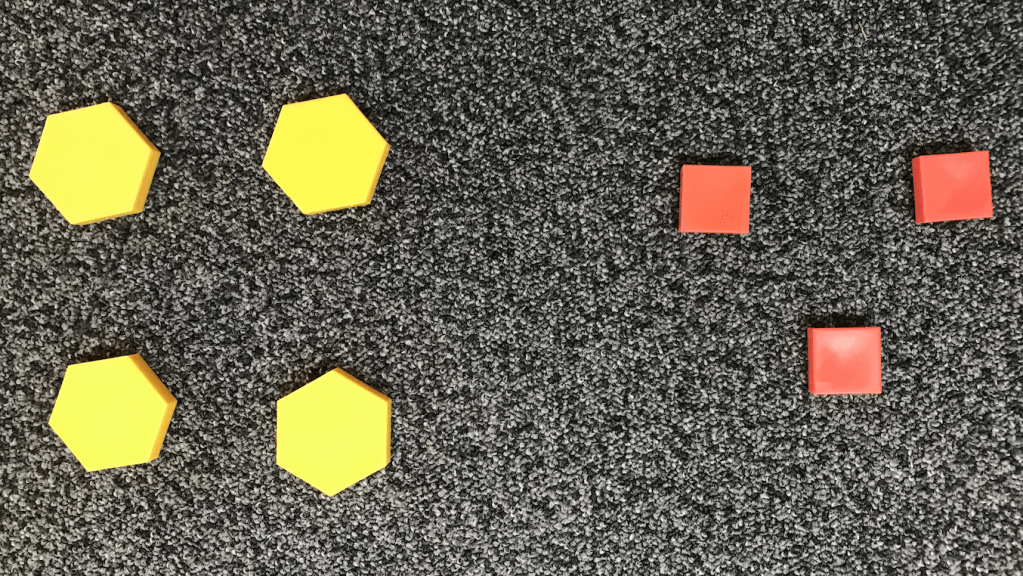
Pattern blocks are a great way for young learners to explore the concept of More Than and Less Than because they can be sorted easily by color and by shape. Children can start using terms such as “square” and “hexagon” in their vocabulary when talking about math and still easily be able to categorize them without getting into the concepts of number of sides. Children can either make groups that show the concept of more or less or make puzzles for their friends to challenge them to determine which one has more and which one has less.
Creative Counters
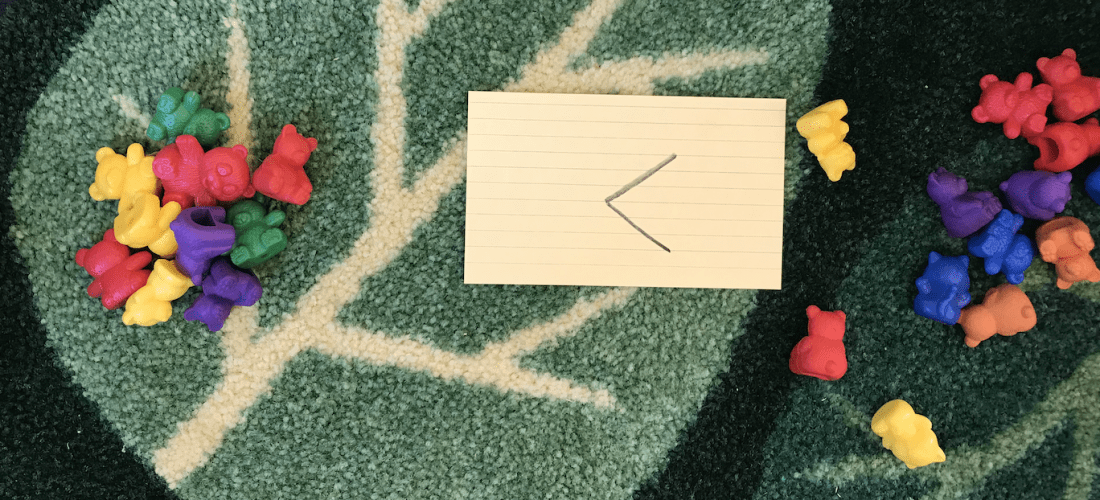
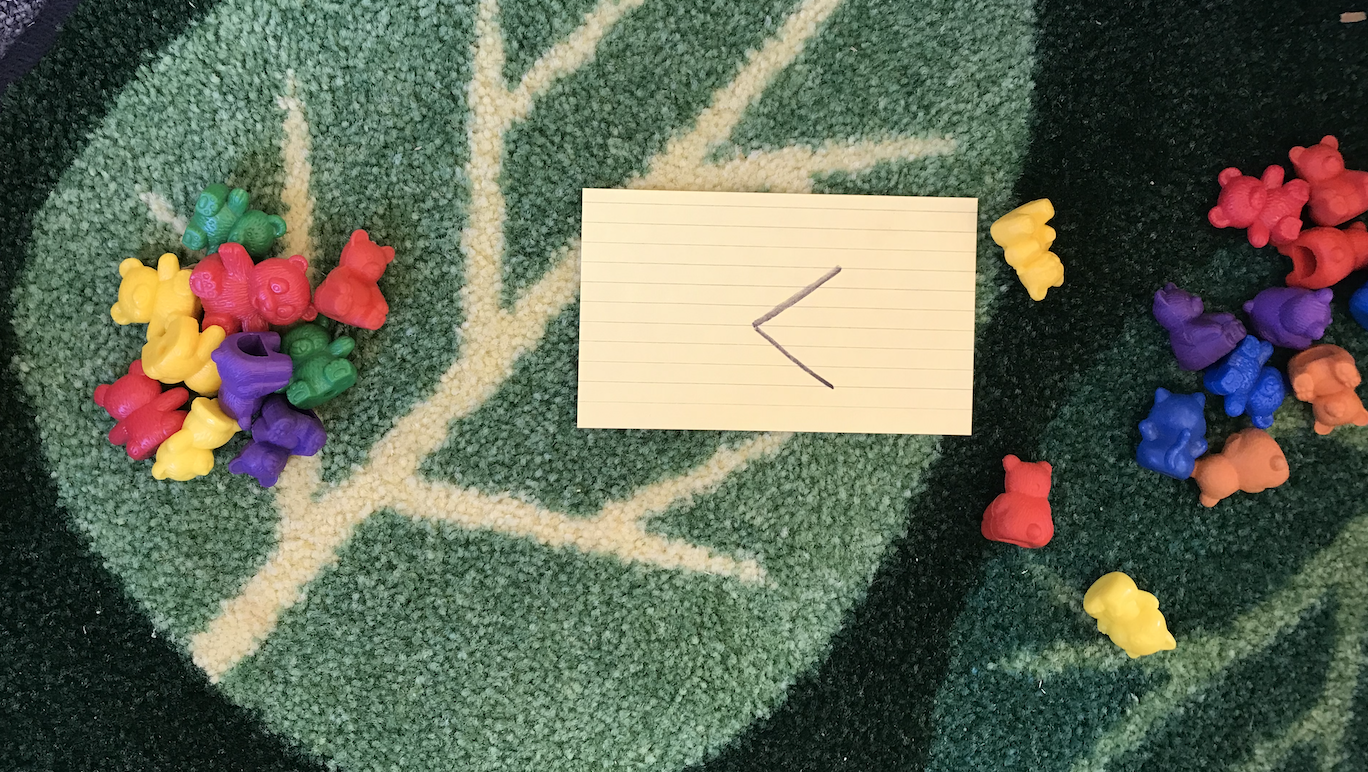
What counters do you have in your classroom that kids are already familiar with and love using? For me, it’s these little teddy bears. For this activity, the children found a partner and each played the game “How Many?” by reaching into the bin to pull out one handful of bears. Each partner counted how many bears they had and then the team determined who had more and who had less. We introduced the greater than and less than symbols, but the kids can also verbally talk about how many they got.
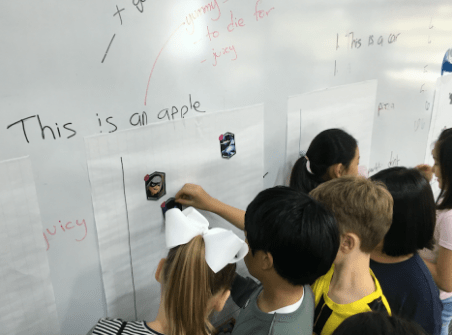
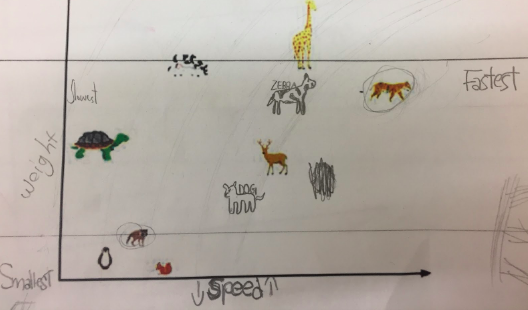
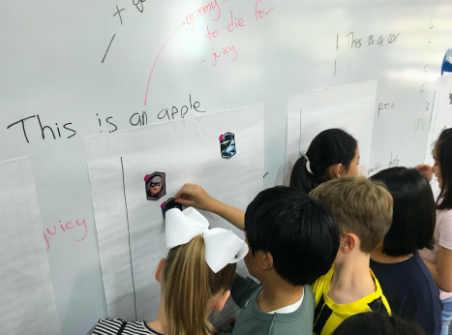
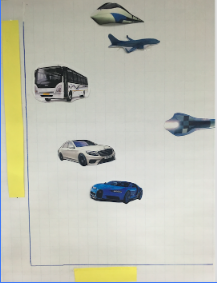
Take a look at the image on the left. What do you notice? You may recognize this image to be a graph. You may also know that this graph comes from a lesson written by inquiry mathematics advocate Jo Boaler. Boaler’s goal in her lesson, is for students to understand that graphs show comparisons. However, you’ll notice one difference between the image on the left and the image Boaler uses in her lesson plan. In this image, I have taken out the labels on the axis. My reasoning? Because I believed my students could figure that part out themselves.
I asked the following set of questions to my 4th grade classes.
Sample Student Work
What can you tell me about this image?
What would you label the axises?
Where would you place a zebra? What about a dog?
Not only were my students able to correctly label the axises, but they also were able to infer where a dog and where a zebra would be appropriately placed on the graphs. Interestingly, each group had their own perspective as to where a “dog” and where a “zebra” would go providing opportunity for a unique classroom discussion on perspective. There can be different breeds of dogs, so why couldn’t this be placed differently!
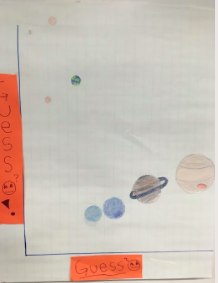
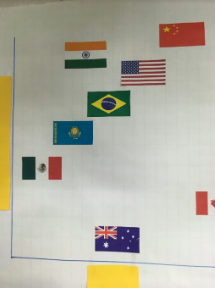
Good inquiry mathematics stretches with the ideas of the children in the classroom. We took this one day exercise and turned it into a 3-day math project, as students wanted to create their own graphs similar to Jo Boaler’s animal one. My students researched topics such as flags of countries and weights of planets, and built their own graphs comparing and contrasting areas of interest. While starting off as just a math lesson, this project grew to incorporate geography, science, and social studies into math.
Some examples of my student’s final graphs. They wanted to leave the axis’s off to have other peers and community members guess what they were comparing on their graphs. Can you guess?
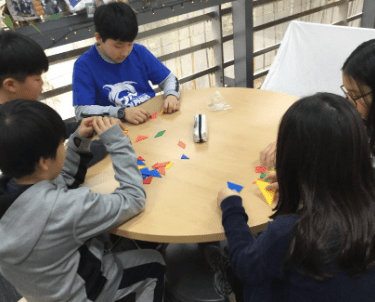
For this math lesson, I broke my students into small groups and allowed them time to play with tangrams to explore how the shapes fit together. Once they had about 5 minutes to play, I asked them some guiding questions to begin discovering fractions.
How many times does the small triangle fit into the larger triangle?
How many times does it fit into the small square?
If the small triangle fits into the small square 2 times, what fraction of a small square is a small triangle?
Of course these questions were basic for my 4th grade students, but I wanted them to determine that although all the shapes are different sizes, each shape can be measured using the smallest triangle.
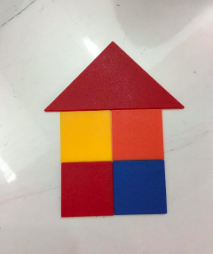
Next, I let my students play again! I gave my students 5 more minutes to play with the pieces but told them that by the end of the 5 minutes they must have some sort of picture created with the blocks. This picture should not have more than 10 pieces, and should include at least 3 different colors of pieces. I showed them this picture of a house as a simple picture I made using my requirements.
Once each group of students agreed on a picture, I first went around and took a picture of each one. This is mostly because I didn’t want someone to bump the table and the kids to not remember what color piece went where. With the images documented, I had my students pull out their math notebooks to answer the following question: What fraction of your total picture is each color?
Answering was a challenge for many of my students. Even with the guiding questions at the beginning, I had students tell me that in the picture on the right blue is 3/10th of the total because 3 pieces were blue out of 10 total. But with some patience and some partner work, most of my students came to quickly understand this misconception and determine a strategy to accurately answer this journal prompt!
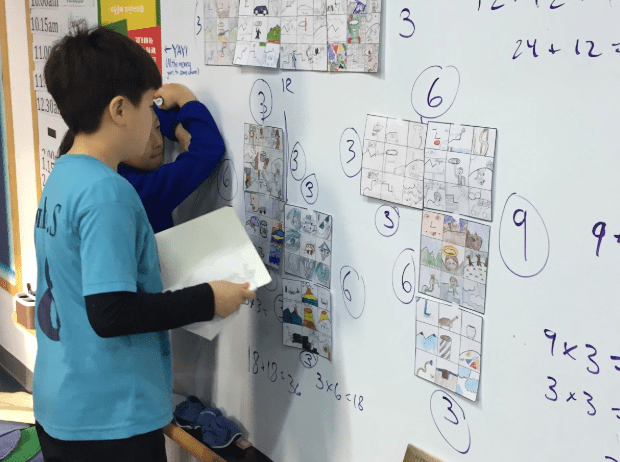
As an introduction to compound shapes I arranged pieces of artwork my students had completed into three different shapes on the board: an L, a snake, and a straight line. The artwork came directly from our unit on imagination, where students drew pictures to fill a nine frame square.The kids loved using their art as the base of math, connecting to the problem because their pieces were being used on the board.
First, I asked my students: Does each compound shape have the same area? Answers varied and as a class we calculated that each shape does indeed have the same area.
Next, I asked my students: does each compound shape have the same perimeter? Again, answered varied and we calculated as a class that each shape had the same perimeter as well.
For our independent challenge I had students work out an answer to the following question:
Is there a way I can arrange these boxes to have the same area but a different perimeter?
Students loved this challenge as it provided them with an opportunity to disprove the belief that shapes with the same area must have the same perimeter. They ultimately discovered that if they moved these four nine-frame boxes into a square that the area remained 36 square units, but the perimeter switched from being 30 units to being only 24 units around.
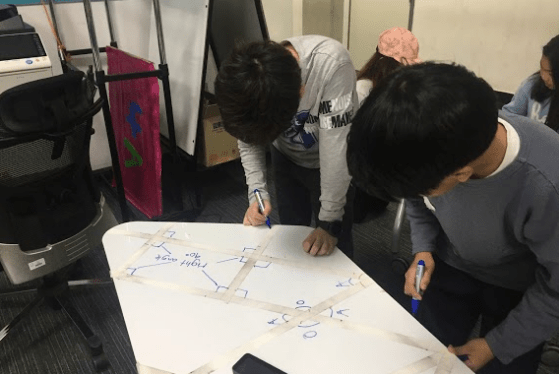
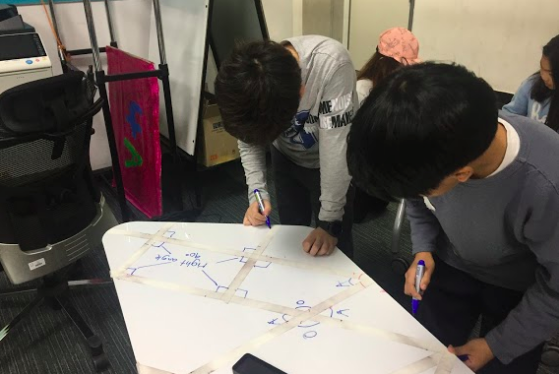
This was a fun center idea for students to determine Obtuse, Acute, and Right Angles. The kids taped up some old tables outside in the common space to create intersections of different sized angles. Next, in small groups the class took turns labeling each angle with it’s corresponding name based on it’s size.
Labeling Tables
A few days later, once we introduced angle degrees and measurement using protractors, the kids were again able to use these tables in small groups, this time to measure how big each angle was. The tape provided an extra challenge, as the kids figured out they needed to measure from the inner tape line
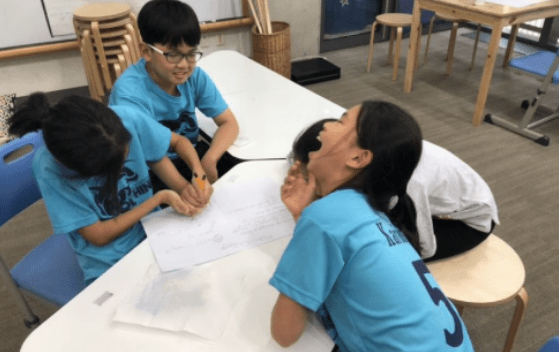
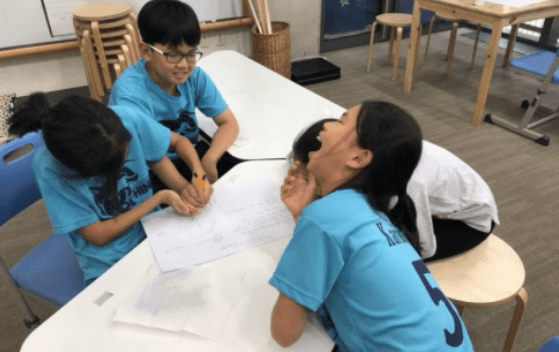
I believe Math Talks are one of the best methods to both challenge advanced students and support struggling students. In a math talk, students are given a problem, or question, to which there may be one or multiple answers, but there are many strategies of which this answer(s) could be found.
Steps to a Successful Math Talk
Have students work individually on the problem or question introduced– I tell my students, if you have figured out one way to solve the problem, do another. Find as many strategies or solutions as you can.
Walk around and jot down what methods students are using– I keep a running list of strategies that both work and do not work with names next to them so I have a plan for who to invite up to share their work.
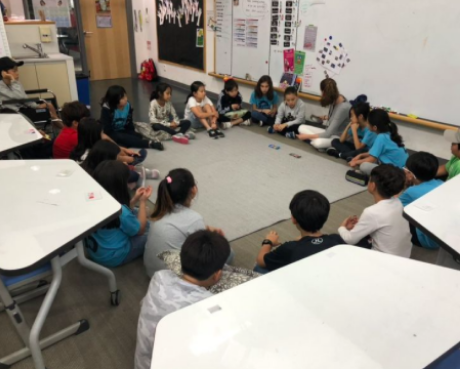
Come back together as a class to share– I call on the students who’s names I wrote down and tell them which strategy I would like them to talk about.
Students teach each other– I used to write down the answers for my kids and have them talk through their thinking as I write, but I’ve found that once my class feels comfortable with each other, the students can write and explain their own strategies while using their presenting skills.
Allow the class to ask follow-up questions once a student shares– I also ask clarifying questions, especially if the student arrived at an incorrect solution so that as a class we can discuss the misconception. At the end of each share, I ask the class, who else used this strategy? This is important as it allows students who were not asked to share to be recognized for their work.
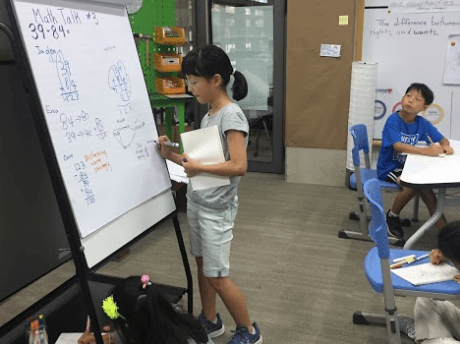
We use Math Talks quite frequently in my 4th grade classrooms. I found the Math Talk from which these pictures are taken to be a great pre-assessment for my students in terms of addition. Most of my students were able to use the standard algorithm for addition to solve the question 39+84=. Many of my students chose to use some type of visual representation for the problem, either a number line, or an organizer with breaking apart the numbers. One of my advanced students was even able to recognize that 39 and 84 are both divisible by 13 and solved this problem by first dividing each by 13 then multiplying 13 by the total he divided by.
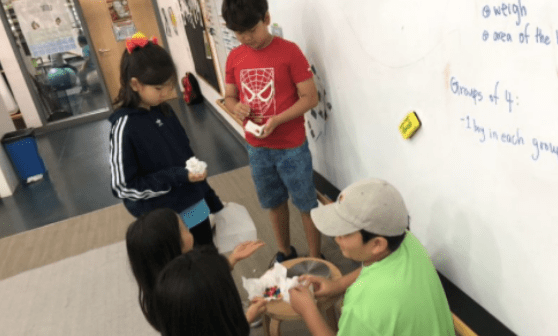
Who doesn’t like mixing food with learning? Today we investigated how many M&M’s we thought were in one bag using a scale to weigh in grams. As a whole class, we inquired into how the scale works, playing with it’s functions. Next, I drew popsicle sticks to determine groups of four students to work together to reach a conclusion of how many candies there were. The group got to pick either a crispy bag of m&m’s or a regular bag of m&ms to experiment with. The rules were simple: use any strategy you want to figure out how many m&m’s are in the bag. Yes, you can open the bag and use the m&m’s but no, you cannot count the m&m’s one by one, you must somehow use the scale.
Hint: Look at the back to figure out what the total weight of the package is.
Working in small groups to organize our thinking Weighing the M&M’s in small amounts
The results for this lesson were varied. Many students got frustrated since when they weighed only one m&m the scale weighed 0kg but when they weighed two m&m’s it sometimes weighed 2kg. Regardless, the students had fun, used teamwork, developed skills on how to use a scale, and were creative in their approaches to get reasonable results whether or not they were totally accurate.
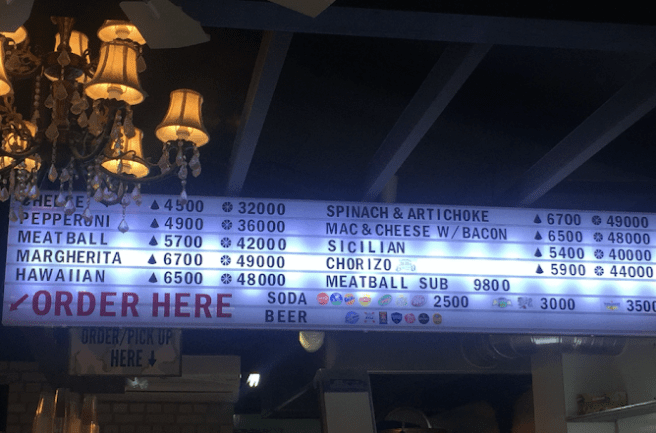
During a weekend trip to Seoul, I went to a pizza shop in Itaewon selling a wide variety of types of pizza. My friend and I debated over whether we would pizza multiple slices or a whole pizza, and ultimately decided that we would go for slices to try more kinds. Good thing we did since each slice was huge, and 3 slices made up half a pizza! This got me thinking . . . mathematically, this wouldn’t make sense for the pizza shop to even sell whole pizzas at all! This is how I got my idea for a lesson I taught the next day at school.
Act I: What do you notice in this picture? What do you wonder about what you are looking at?
Students discussed that this must be a pizza shop and how the numbers represented the prices. They determined that triangles must mean prices for single slices and circles must mean prices for full pizzas.
Act 2: How many slices do you think the pizza shop should sell in their whole pizzas?
We discussed what they remembered from a previous unit on businesses and how businesses normally price items in order to make a profit.
Act 3:This pizza shop sells 6 slices per pizza. How does this compare to your answer? Do you think the pizza shop should change the number of slices per pizza? Why or why not?
Let’s talk about money. As a hardworking parent, you know the value of it. That’s why when you pick your child up from school and they ask if you can stop at Target on the way home, your immediate answer isn’t always yes. It may seem like your child doesn’t have a “money mind” yet, however that’s just not true. Does he or she have a piggy bank at home? My students do. I’m willing to bet there’s not more than a couple dollars in there, but whatever there is saved, it’s heavily guarded not to be touched by siblings, pets, and especially parents (or homeschool teachers!). Kids love money, and from an early age learn to differentiate a penny from a nickel, dime, and quarter. Likely, your child already knows how much each coin is worth. This sets you up for the ultimate fun, money, challenge for some hands-on math action.
Materials: – Suggestion: 61 cents (3 dimes, 5 nickels, and 6 pennies) – a paper – a pencil
Grade Level: Suggestion is based on 1st grade math standards. For older students, add quarters or even dollars to this activity.
Below are two activities for you to try, one addition and one subtraction. Before you begin, make sure to review with your child each coin’s name and amount its worth.
Activity 1: How many combos? (Addition)
Write down a number at the top of your child’s piece of paper. I would start with a low number, like 7, to get them started. Tell them that their job is to use the coins in front of them to make 7 cents. They can use any combination of coins. Once they find the nickel and 2 pennies, congratulate them on adding money and ask them to write the number sentence they just created! You might need to help them start by writing ____ + _____ + _____= 7 on their empty sheet of paper to fill in the blanks.
Increase the amount in your next problem by choosing a slightly higher number, like 11. Allow your child to explore how to make the number again using the coins.
Once your child has gotten a chance to use all the coins, challenge them to create as many different combinations of coins as possible to make one single number. For example, for the number 26, your child might at first choose 5 nickels, adding them together to make 25, then an additional 1 penny. Another combination could be 1 dime, 3 nickels, and 1 penny. A third combination could be 2 dimes, 1 nickel and 1 penny. (There’s even more combinations!) This is exciting, because your child gets to discover new patterns and combinations as he or she completes each number! There’s not “one right answer” for any given problem, allowing your child the space to take risks, and creatively problem solve.
Continue to have your child write down number sentences as you go, to develop an understanding for mathematical equations. This is a great activity for many reasons, one being that often kids don’t have much hands-on experience transferring physical amounts to a written expression. This activity allows your child to build expression writing skills with groups numbers of 1s, 5s, and 10s.
Activity 2: Sub(traction) Shop!
Take a toy your child has lying around nearby (seriously, any toy!) and tell them you are going to buy it from them. Make up a number that is less than the number of coins you have (61 cents or however much). Maybe you’re going to buy their barbie doll for 25 cents. Or in my case, I first purchased a playdough box for 13 cents then a playdough ice cream cone for 38 cents. Instead of paying with the correct amount however, count out a higher number and hand it over to your child (make sure there is enough coins left for the change). Explain to your child that you only had those coins in your pocket that day and then ask for change. Your child might need to write down what you paid them, and then a reminder on how much the item cost to begin with! But once there is a number sentence written on the piece of paper, he or she can use their mathematical abilities to calculate how many cents you are owed back, and in what combination of coins!
After this first purchase, your child likely will enjoy picking out items (toys) themselves for you to buy. Have your child this time pick how much each item should cost. The more you can make this their choice, the more engagement your child will have. I love this activity because it’s the perfect combination of play and math, and who knows? Maybe this will help them one day with that career in Sales!
Ah Word Problems.Everyone’s favorite kind of math problem! I remember absolutely dreading whenever one of these written horrors showed up on one of my school work pages. Luckily, there’s a way for you to do a word problem with your child without them even making the association . . . how? become the problem!
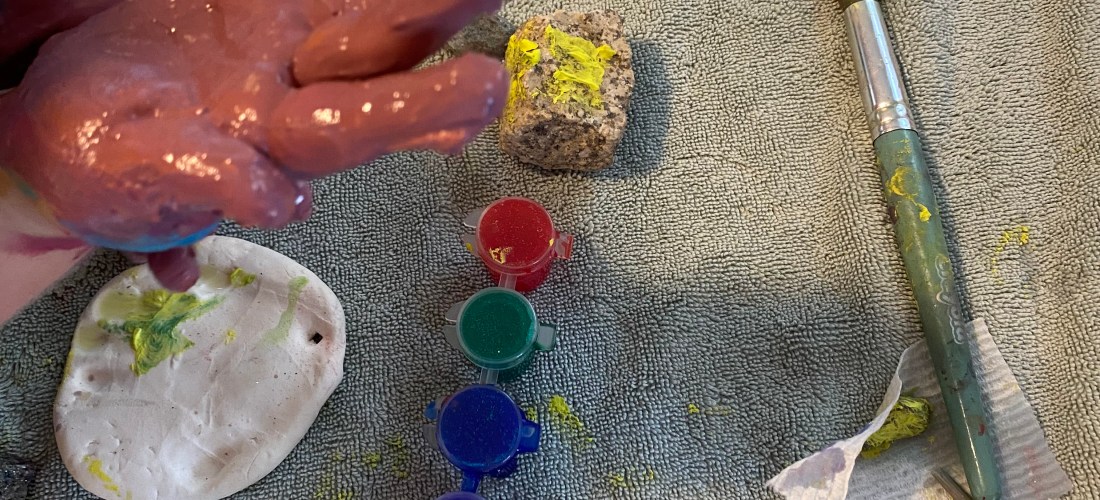
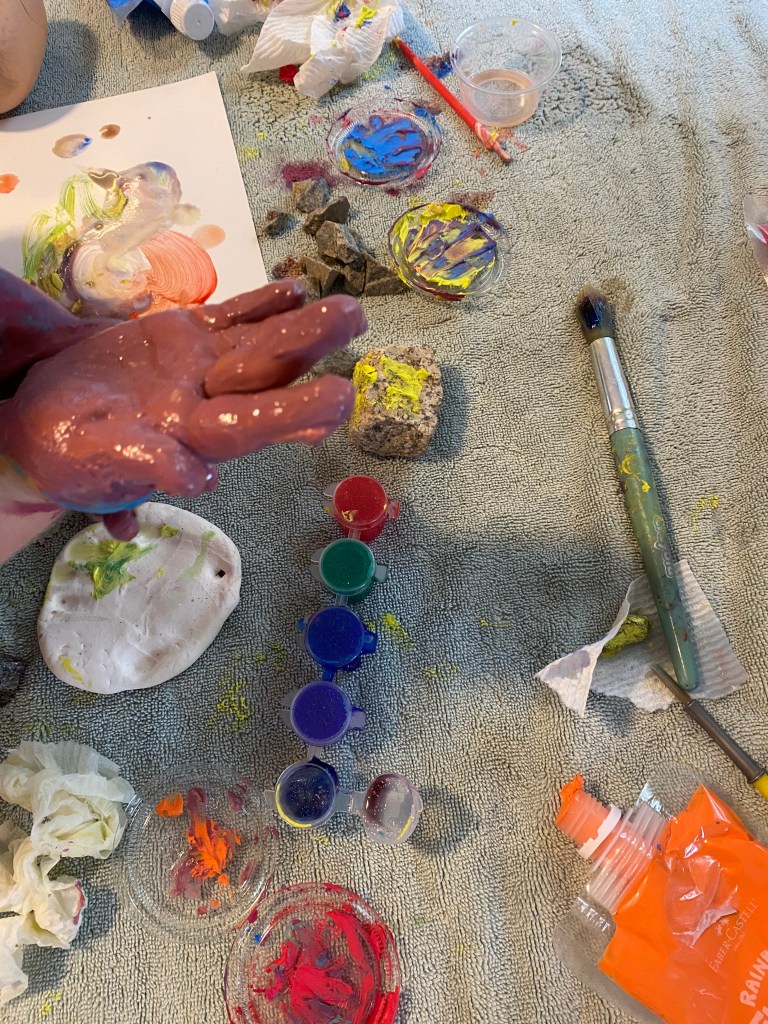
It was my student’s birthday this week, so to celebrate I bought her a container of fluffy paint! This fun activity had a little secret though upon unwrapping, it was the base component of a hands-on mathematical afternoon adventure. My word problem went like this-
Painting on Rocks or our Hands?
a. B and E went to the park and collected 20 rocks. When they got home, they decided to paint 6 of the rocks E’s favorite color! How many rocks were left unpainted? (20-6=?)
b. After they painted the 6 rocks, the girls decided to paint 3 more rocks B’s favorite color. How many rocks are now left unpainted?
When disguised as a walk to the park, math becomes just that! We gathered 20 rocks from the outdoors, excited to bring them back to the kitchen to paint. Then we got a little messy, discovering all the joys (puffy paint is puffy!) and horrors (puffy paint is very sticky) associated with the project. Eventually, 6 rocks were painted and ready to dry before we were able to complete the problem.
Although this version of math took a lot longer then your typical work sheet, it was memorable, interactive, and enjoyable by all parties involved. Math was conveyed as an avenue to solve a read-life problem, rather then some characters on a sheet of paper. And even better, this kind of math fit into fun activities my student truly wanted to do during her birthday celebrations! A double win 🙂
So how can you replicate this technique at your house? Get creative. It’s not always about the rigor of the problem, sometimes its about the connections your child can make between math and real life. I challenge parents to use word problems in their child’s everyday routines to get the most out of an ordinary day.
Other examples you could use:
Doing math at bed time:
________ has 18 stuffed animals. _________ brings 5 stuffed animals to bed with him. How many stuffed animals sit in mom’s rocking chair?
Doing math at breakfast:
_______ gets 17 cheerios in his bowl. He eats 11. How many cheerios are left in the bowl?
Doing math when getting dressed:
_______ has 5 dresses, 3 pairs of pants and 4 shirts to choose from when getting dressed. How many clothing items does she have altogether?



 Sonia Richmond