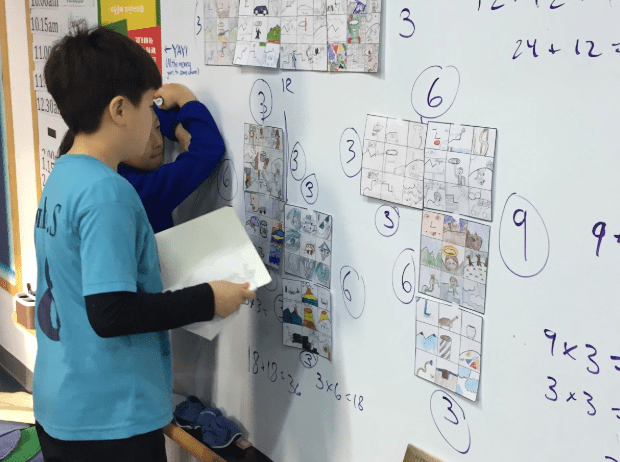
As an introduction to compound shapes I arranged pieces of artwork my students had completed into three different shapes on the board: an L, a snake, and a straight line. The artwork came directly from our unit on imagination, where students drew pictures to fill a nine frame square.The kids loved using their art as the base of math, connecting to the problem because their pieces were being used on the board.
First, I asked my students: Does each compound shape have the same area? Answers varied and as a class we calculated that each shape does indeed have the same area.
Next, I asked my students: does each compound shape have the same perimeter? Again, answered varied and we calculated as a class that each shape had the same perimeter as well.
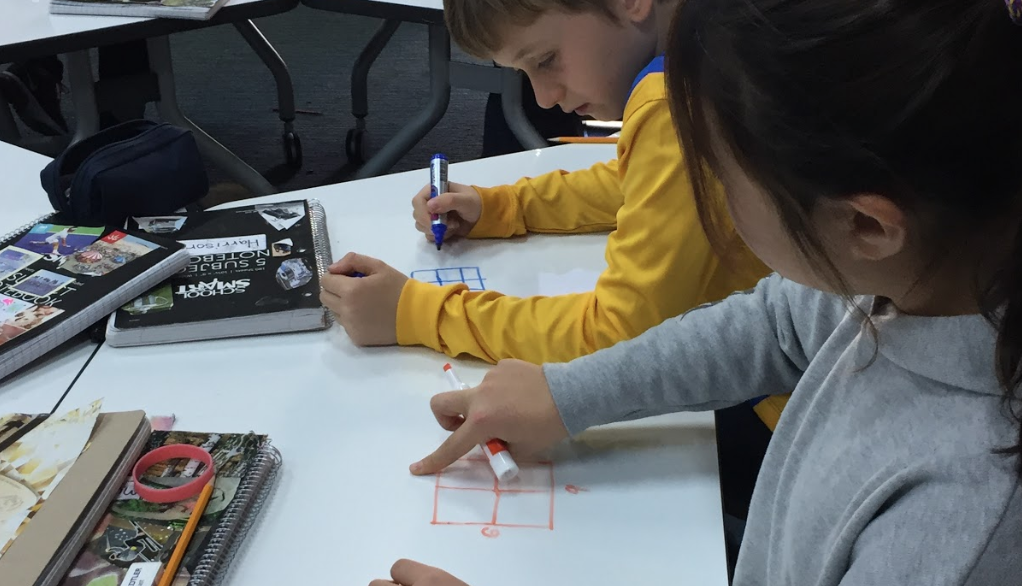
For our independent challenge I had students work out an answer to the following question:
Is there a way I can arrange these boxes to have the same area but a different perimeter?
Students loved this challenge as it provided them with an opportunity to disprove the belief that shapes with the same area must have the same perimeter. They ultimately discovered that if they moved these four nine-frame boxes into a square that the area remained 36 square units, but the perimeter switched from being 30 units to being only 24 units around.
 Sonia Richmond