
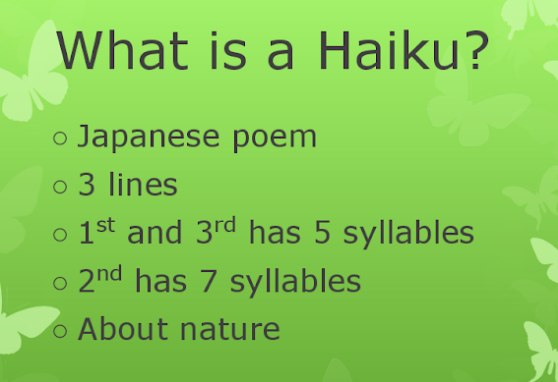
One day, I was asked to substitute as the homeroom teacher in one of the 4th grade classrooms I intern taught in. The regular homeroom teacher provided me with the lessons he was planning on doing that day including two power-point presentations; one on Haikus and one on similies. Each power-point conveyed information to the students in a lecture format with limited student engagement.
I decided to revamp these lessons, giving my students credit for the knowledge they already knew. Instead of following these plans, I used the content as guidelines for an inquiry based approach. Here is the first lesson I did on Haikus.
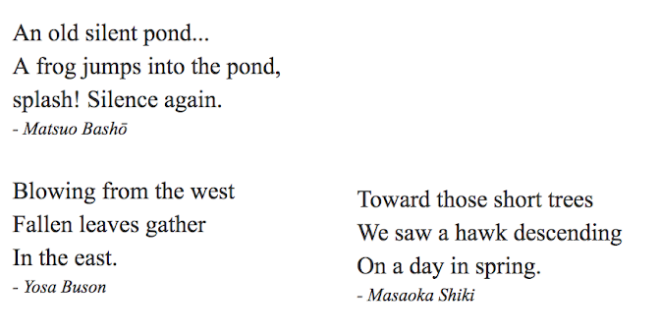
I put these three poems up on the board, and asked my students:
What do the following poems have in common?
Student Answers:
- They’re about nature
- I think they might be Haikus
- The first and third poems are Haikus because they follow 5-7-5 syllable pattern
- Could they all be Haikus even if they have a different syllable pattern?
- They have to do with the seasons
- They have to do with movement
- I think the poets might be European looking at their names?
- I know Haikus are Asian, are they Chinese?
- The poets are Japanese
My students came up with the same ideas that were on the bulleted list in the power-point and more. They also had the opportunity to analyze famous poems that will likely emerge again throughout their education and life. This was a powerful moment for me as a first year PYP teacher, as I proved that showing students stacks of texts and having them analyze the content of strong writing, teaches more about a genre than an informational lecture.
 Sonia Richmond